
Upholstery fabric is far more than a surface covering. It is the intersection of structural engineering, aesthetic design, and material science — determining how a piece of furniture looks, feels, and lasts. As interior design trends shift toward textured, tactile surfaces, manufacturers and designers alike are seeking fabrics that deliver both visual depth and long-term durability.
Zhejiang Wanjie Textile New Material Co., Ltd., established in 2007, has positioned itself as a leading innovator in this space — offering a wide portfolio of technical textile products engineered specifically for upholstery, home décor, and contract interiors.
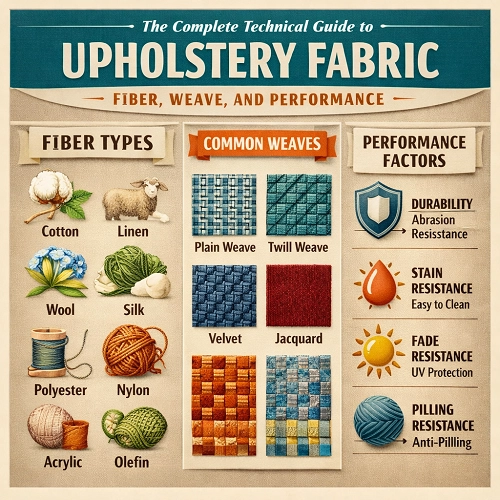
Upholstery fabric refers to any textile applied to the surface of furniture — sofas, armchairs, headboards, ottomans, and dining seating. Unlike apparel or industrial textiles, upholstery fabric must simultaneously meet demanding performance criteria: abrasion resistance, colorfastness, dimensional stability, and tactile comfort.
The choice of fabric fundamentally shapes the character of a piece. A tight, smooth weave reads as contemporary and formal; a deep pile or three-dimensional texture lends warmth and a more relaxed, luxurious character. Understanding the technical parameters behind these effects empowers both procurement teams and interior designers to make informed choices.
The fiber content of an upholstery fabric is its first and most consequential specification. Each fiber type introduces a distinct performance profile — influencing everything from abrasion resistance and drape to dyeability and moisture management.
| Fiber | Abrasion Resistance | Colorfastness | Moisture Absorption | Typical Use |
| 100% Polyester | Excellent | Excellent | Low | Burnout, velvet, twill, 3D textures |
| Polyester/Spandex Blend | Very Good | Good | Low–Moderate | Stretch upholstery, seating panels |
| Cotton | Moderate | Moderate | High | Casual, traditional upholstery |
| Cotton/Polyester | Good | Good | Moderate | Corduroy, printed fabrics |
| Viscose/Rayon | Low–Moderate | Moderate | High | Velvet blends, decorative accents |
| Nylon | Outstanding | Good | Low | Commercial/contract upholstery |
Wanjie's flagship Burnout 3D Twill (reference B-3D0002) is made from 100% polyester — a deliberate engineering choice. Polyester's tight molecular structure makes it inherently resistant to pilling, fading, and distortion under repeated mechanical stress, all of which are critical in high-contact upholstery environments.
Beyond fiber, the weave structure defines a fabric's surface geometry, mechanical behavior, and visual personality. Three structural families dominate the upholstery market: plain weaves, twill weaves, and pile constructions.
Twill weaves produce diagonal ribs across the fabric surface by offsetting the interlacing points of warp and weft threads. This geometry increases thread density, producing a fabric that is stronger, more supple, and more resistant to soiling than plain weaves of equivalent weight. When combined with burnout processing — as in Wanjie's Burnout 3D Twill — twill structures gain an additional spatial dimension: selectively dissolving certain fibers creates topographic variation across the surface, producing the three-dimensional relief that defines the 3D effect.
Pile fabrics — including velvet and corduroy — introduce loops or cut fibers that stand perpendicular to the base cloth. This vertical pile catches light at multiple angles simultaneously, producing the characteristic optical depth and soft hand-feel these materials are known for. Wanjie's Velvet Series and Corduroy Series represent both ends of this structural spectrum — from the smooth, continuous pile of velvet to the ribbed channels of corduroy.
Burnout (also called devoré) is a chemical-mechanical finishing technique that selectively removes fibers from a base fabric using an acid paste or alkali solution. In polyester-based burnout fabrics, the process exploits differential fiber chemistry: the acid or paste destroys one fiber component (typically a natural or regenerated cellulosic fiber in a blend, or structurally segregated zones in 100% synthetics) while leaving the base structure intact.
"The burnout process transforms a flat textile surface into a sculptural object — creating patterns with genuine topographic depth rather than printed illusion."
In Wanjie's Burnout Series, this technique is applied across multiple structural formats — from the ribbed geometry of the Burnout 16 Wales 3D to the classic diagonal relief of the Burnout 3D Twill. Each variant combines the burnout chemical process with a distinct base weave architecture.
| Product | Reference | Weight | Width | Composition |
|---|---|---|---|---|
| Burnout 3D Twill | B-3D0002 | 180 GSM | 150 cm | 100% Polyester |
| Burnout 16 Wales 3D | B-3D0016 | — | — | 100% Polyester |
| 3D Wales | B-3D0001 | — | — | 100% Polyester |
| Burnout 21 Wale | B-1905 | — | — | 100% Polyester |
| Burnout 21 Twill | B-2248 | — | — | 100% Polyester |
| Burnout T Pattern | B-2223 | — | — | 100% Polyester |
| Burnout Grid Plus | B-2220 | — | — | 100% Polyester |
| Burnout Bark Plus | B-2229 | — | — | 100% Polyester |
When evaluating any upholstery textile for commercial or residential application, procurement teams typically assess a standardised set of performance metrics. Understanding these parameters allows for more precise specification and fewer costly substitutions mid-project.
| Specification | Test Standard | Residential Minimum | Contract Minimum |
|---|---|---|---|
| Abrasion Resistance (Martindale) | ISO 12947 | 15,000 cycles | 30,000+ cycles |
| Pilling Resistance | ISO 12945-2 | Grade 3–4 | Grade 4–5 |
| Colorfastness to Light | ISO 105-B02 | Grade 4 | Grade 5+ |
| Colorfastness to Rubbing | ISO 105-X12 | Grade 3 (wet) | Grade 4 (wet) |
| Tear Strength | ISO 13937 | ≥ 20 N (warp/weft) | ≥ 35 N |
| Weight (GSM) | ISO 3801 | 150–250 GSM typical | 200–400 GSM typical |
| Width Stability | ISO 5077 | ±3% | ±2% |
At 180 GSM and 150 cm width, the Burnout 3D Twill sits comfortably in the residential upholstery range — offering sufficient body for sofa and chair applications while retaining the drape necessary for headboards and decorative panels. The 100% polyester composition supports high abrasion cycle performance and excellent colorfastness ratings, both critical for longevity in daily-use furniture.
Modern upholstery fabric is no longer confined to traditional sofas and armchairs. The categories of application have expanded significantly, with fabric now playing a structural and acoustic role as well as a purely aesthetic one.
For residential interiors, three-dimensional textures such as the Burnout 3D Twill add tactile warmth to living areas without requiring elaborate surface treatments or decorative accessories. A single upholstered sofa in a burnout twill can serve as the visual anchor of an entire room scheme. In commercial contexts — hospitality, corporate lobbies, healthcare waiting areas — the emphasis shifts toward durability and ease of maintenance, where polyester's resistance to staining and fading becomes the primary selection criterion.
The Spandex Series from Wanjie further extends the application range into seating systems that require shaped panels and tight three-dimensional upholstery, where stretch and recovery performance are essential. Meanwhile, the Mesh Series addresses ventilated seating and outdoor furniture, where breathability and UV resistance take precedence.
Founded in 2007, Zhejiang Wanjie Textile New Material Co., Ltd. operates across six primary product series, each addressing a distinct segment of the upholstery and apparel fabric market. The company holds multiple patents and industry certifications, underpinning its reputation as a technically credible supplier for global export markets.
A defining feature of Wanjie's commercial proposition is its flexibility on customisation. Standard stock specifications — such as the 180 GSM, 150 cm parameters of the Burnout 3D Twill — serve as a baseline, but colour, weight, and width are adjustable to project requirements. This is particularly valuable for large-scale furniture manufacturers or contract interior design firms that require precise colour matching against existing scheme standards or specific GSM ranges dictated by cutting and sewing line requirements.
For procurement teams evaluating international suppliers, Wanjie's certifications and patent portfolio provide a level of technical assurance beyond sample-based assessment. The combination of in-house development capability and export-oriented production infrastructure positions the company as a viable primary source for large-volume, specification-driven orders.
To initiate a sourcing inquiry or request fabric samples, the Wanjie team can be reached directly via the contact page or by email at info@wanjietex.com.
Selecting the right upholstery fabric requires navigating a genuinely complex matrix of fiber science, weave engineering, surface finishing, and performance specification. Three-dimensional burnout fabrics such as the Burnout 3D Twill illustrate how advanced textile processing can bridge the gap between aesthetic ambition and functional durability — delivering surfaces that are simultaneously visually compelling and engineered for long-term use.
As the upholstery market continues to demand greater textural sophistication alongside consistent technical performance, manufacturers like Zhejiang Wanjie Textile — combining over 15 years of material innovation with a broad, customisable product portfolio — represent a strategically important category of supplier for the global furniture and interiors industry.